2026 Tax Code Changes: Maximize Capital Gains Savings by 15% Before December
Advertisement
The financial landscape is constantly evolving, and staying ahead of significant legislative changes is paramount for safeguarding your wealth. As we approach the end of the current tax cycle, a critical juncture looms: the impending 2026 Tax Code Changes. These changes, particularly those impacting capital gains, could have a profound effect on your investment portfolio and overall financial health. Understanding these shifts and implementing strategic planning now can help you maximize your capital gains tax savings by a significant margin, potentially up to 15% or more, before the December deadline.
Many provisions of the Tax Cuts and Jobs Act (TCJA) of 2017 are set to expire at the end of 2025, ushering in a new era of tax regulations in 2026. This means that without proactive measures, investors could face substantially higher tax liabilities on their capital gains. This comprehensive guide will delve into the specifics of the 2026 Tax Code Changes, highlight the potential impact on your investments, and provide actionable strategies to mitigate these effects. Our goal is to equip you with the knowledge and tools necessary to navigate these changes effectively, ensuring you are well-prepared to optimize your tax position before the clock runs out.
Understanding the Impending 2026 Tax Code Changes
The core of the upcoming tax shift lies in the expiration of several key provisions from the TCJA. When enacted, the TCJA brought about significant reductions in individual income tax rates, increased the standard deduction, and made various changes to business taxation. While some aspects of the TCJA were made permanent, many of the individual tax provisions were temporary and are scheduled to sunset on December 31, 2025. This sunset effectively reverts many tax parameters to their pre-TCJA levels, leading to what could be a substantial increase in tax burdens for many Americans, especially those with significant capital gains.
Key Provisions Set to Expire
- Individual Income Tax Rates: Income tax rates for individuals are expected to revert to higher pre-TCJA levels. For example, the top marginal individual income tax rate, currently 37%, is slated to return to 39.6%. This has a direct impact on how capital gains are taxed, as qualified capital gains rates are often tied to ordinary income tax brackets.
- Standard Deduction: The increased standard deduction amounts introduced by the TCJA will likely revert to lower levels, adjusted for inflation. This could reduce the tax benefits for many taxpayers who currently take the standard deduction, pushing more income into taxable territory.
- Estate and Gift Tax Exemption: The generous estate and gift tax exemption amounts are also scheduled to be cut roughly in half. This is a critical consideration for high-net-worth individuals and families engaged in estate planning.
- Child Tax Credit: While not directly related to capital gains, changes to the Child Tax Credit (CTC) can impact overall tax liability and the ability to offset other income. The credit amount and refundability rules are subject to change.
- SALT Deduction Cap: The $10,000 limitation on state and local tax (SALT) deductions is set to expire. While this might seem beneficial for residents in high-tax states, the overall increase in other tax liabilities could outweigh this benefit for many.
Direct Impact on Capital Gains Taxation
The most immediate and significant impact of the 2026 Tax Code Changes for investors will be on capital gains taxes. While the statutory long-term capital gains rates (0%, 15%, 20%) are not directly set to change, their application is tied to ordinary income tax brackets. As ordinary income tax brackets rise, more individuals will find themselves pushed into higher capital gains tax brackets. For instance, someone currently in the 15% long-term capital gains bracket might find themselves in the 20% bracket due to higher ordinary income rates, or simply because the income thresholds for those brackets have shifted downwards.
Advertisement
Furthermore, the 3.8% Net Investment Income Tax (NIIT) remains in effect and applies to certain net investment income, including capital gains, for individuals with modified adjusted gross income (MAGI) above specific thresholds ($200,000 for single filers, $250,000 for married filing jointly). This tax is independent of the TCJA changes but adds another layer of complexity to capital gains taxation that taxpayers must consider when planning for the 2026 Tax Code Changes.
Why December is Your Critical Deadline
The December 31, 2025, deadline is not just an arbitrary date; it marks the final opportunity to realize capital gains under the current, potentially more favorable, tax regime. Any capital gains realized on or after January 1, 2026, will likely be subject to the new, higher tax rates and potentially less favorable rules. This creates a powerful incentive to review your investment portfolio and execute strategic moves before the end of the year.
The Urgency of Pre-2026 Planning
Waiting until the last minute can lead to rushed decisions, potential errors, and missed opportunities. Proactive planning allows for a more thoughtful and calculated approach. Consider the following:
Advertisement
- Market Volatility: Attempting to sell assets quickly at year-end can be influenced by market conditions. Planning ahead allows you to execute trades when market conditions are more favorable, rather than being forced by a tax deadline.
- Capacity of Advisors: Financial advisors and tax professionals become extremely busy as the year-end approaches. Engaging with them early ensures you receive dedicated attention and comprehensive advice tailored to your unique situation.
- Complexity of Strategies: Some of the most effective tax-saving strategies, such as setting up certain trusts or making large charitable contributions, require time to implement correctly. These cannot be done overnight.
- Capital Gains Harvesting: The concept of realizing gains before rates increase is often referred to as "capital gains harvesting." This is the opposite of tax-loss harvesting, where you sell assets at a loss to offset gains. Here, you might strategically sell appreciated assets to lock in the current lower tax rates, even if you plan to repurchase them later (being mindful of wash-sale rules if applicable within 30 days).
Strategies to Maximize Your Capital Gains Tax Savings
To effectively navigate the 2026 Tax Code Changes, a multi-faceted approach is often best. Here are several strategies to consider, each with its own benefits and considerations.
1. Accelerate Capital Gains Realization
If you have highly appreciated assets that you were planning to sell in the near future, consider realizing those gains before December 31, 2025. By doing so, you can lock in the current long-term capital gains rates, which may be lower than those applicable in 2026. This strategy is particularly relevant if you anticipate being in a higher income tax bracket (and thus a higher capital gains tax bracket) in 2026.
- Identify Appreciated Assets: Review your investment portfolio to identify assets that have significantly increased in value.
- Calculate Potential Tax: Work with a tax professional to estimate the capital gains tax you would owe under current rules versus projected 2026 rules.
- Reinvestment Strategy: If you sell, have a clear plan for reinvesting the proceeds. You might repurchase the same asset (being aware of market timing and potential wash sale rules if repurchasing within 30 days for a loss), or diversify into other investments.
2. Tax-Loss Harvesting
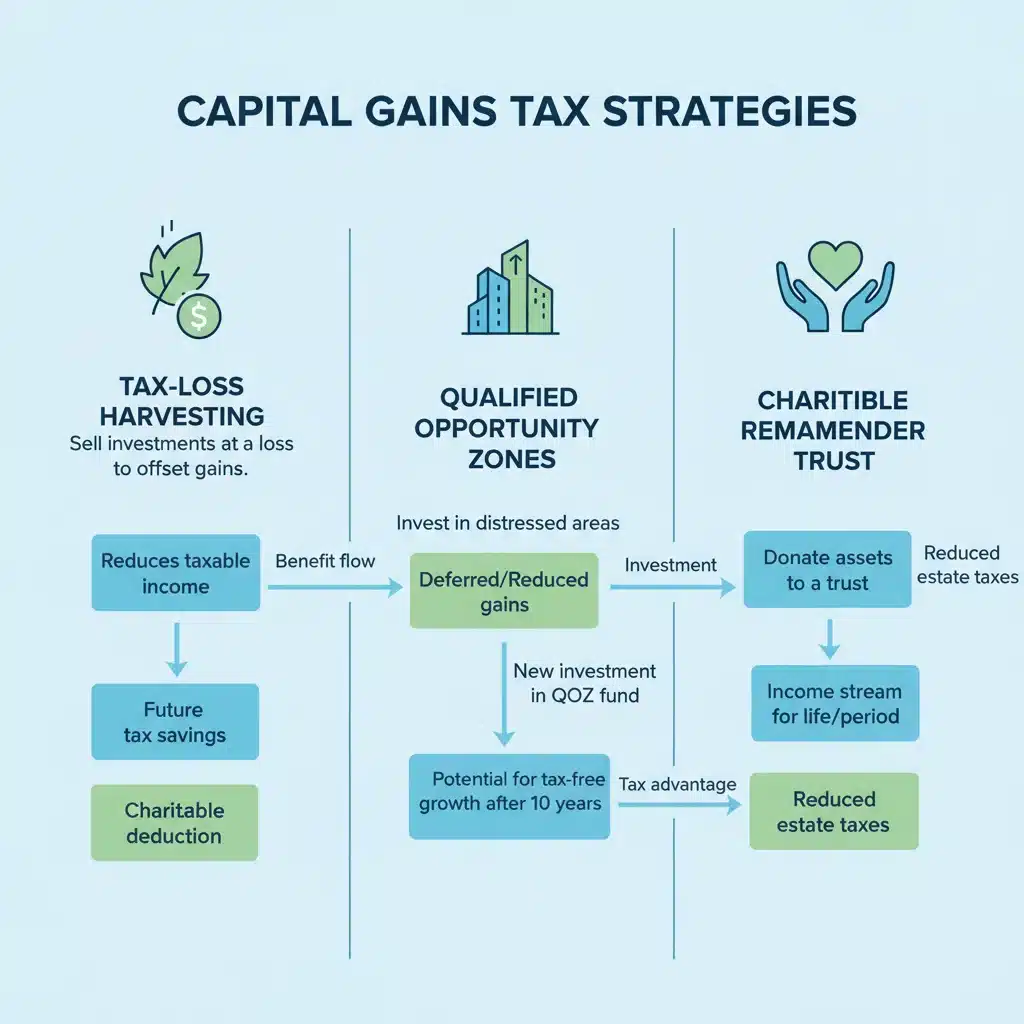
While the focus is often on gains, tax-loss harvesting remains a powerful strategy. If you have investments that have declined in value, selling them can generate capital losses that can offset capital gains. If your capital losses exceed your capital gains, you can deduct up to $3,000 of those losses against ordinary income each year, carrying forward any excess losses indefinitely.
- Offset Gains: Use losses to reduce or eliminate capital gains realized in 2025, thereby lowering your taxable income.
- Reduce Ordinary Income: If losses exceed gains, you can still get a tax benefit.
- Portfolio Rebalancing: Tax-loss harvesting also provides an opportunity to rebalance your portfolio, selling underperforming assets and reinvesting in others that align better with your financial goals.
3. Qualified Opportunity Funds (QOFs)
Qualified Opportunity Funds offer a unique way to defer and potentially reduce capital gains taxes by reinvesting those gains into designated economically distressed communities. While the program has specific rules and timelines, it can be a powerful tool for long-term investors.
- Deferral: You can defer capital gains tax until December 31, 2026, or until you sell your QOF investment, whichever comes first.
- Reduction: If you hold the QOF investment for at least five years, a portion of the original deferred gain is excluded from taxation.
- Exclusion: If you hold the QOF investment for at least ten years, any appreciation on the QOF investment itself becomes tax-free. This strategy is particularly attractive for those with substantial gains looking for long-term investment opportunities with significant tax advantages.
4. Charitable Giving Strategies
For philanthropically inclined individuals, charitable giving can be an excellent way to reduce capital gains taxes while supporting causes you care about.
- Donating Appreciated Securities: Instead of selling appreciated stock and donating the cash proceeds, donate the stock directly to a qualified charity. You generally avoid paying capital gains tax on the appreciation, and you can typically deduct the fair market value of the stock (up to certain limits) if you itemize deductions.
- Charitable Remainder Trusts (CRTs): A CRT allows you to donate appreciated assets to a trust, receive an income stream from the trust for a period of time, and then have the remainder go to charity. This can avoid immediate capital gains tax on the donated assets, provide income, and generate an income tax deduction.
- Donor-Advised Funds (DAFs): DAFs allow you to make an irrevocable charitable contribution of cash or appreciated assets, receive an immediate tax deduction, and then recommend grants to charities over time. This is a popular option for those who want to make a large donation now for tax purposes but wish to decide on specific charities later.
5. Maximize Retirement Contributions
While not directly related to capital gains tax rates, maximizing contributions to tax-advantaged retirement accounts (401(k)s, IRAs, HSAs) can reduce your taxable income, potentially keeping you in a lower ordinary income tax bracket. This, in turn, can keep you in a lower capital gains tax bracket, indirectly helping to save on capital gains taxes.
- Traditional IRAs/401(k)s: Contributions are often tax-deductible, reducing your current taxable income.
- Roth Conversions: If you anticipate being in a higher tax bracket in retirement, consider a Roth conversion while tax rates are relatively lower. While this triggers taxable income now, future qualified withdrawals are tax-free. This could be a strategic move before the 2026 Tax Code Changes if you believe tax rates will indeed rise.
- Health Savings Accounts (HSAs): HSAs offer a triple tax advantage: tax-deductible contributions, tax-free growth, and tax-free withdrawals for qualified medical expenses. This can free up other funds that might otherwise be subject to higher capital gains taxes.
6. Review and Update Your Estate Plan
The impending reduction in the estate and gift tax exemption amounts makes it crucial to review and update your estate plan. For high-net-worth individuals, utilizing the current higher exemption amounts through gifts before 2026 can prevent significant estate tax liabilities down the road.
- Gifting Strategies: Consider making substantial gifts to beneficiaries now, up to the current exemption limits, to remove those assets from your taxable estate.
- Trusts: Explore various trust structures that can help transfer wealth efficiently and potentially reduce future estate taxes.
- Business Succession Planning: If you own a business, the 2026 Tax Code Changes could impact its valuation and transfer. Update your succession plan accordingly.
The Importance of Professional Guidance
Navigating the complexities of tax law, especially during a period of significant change like the upcoming 2026 Tax Code Changes, is not a task to undertake lightly. The strategies outlined above are general in nature, and their applicability and effectiveness depend entirely on your individual financial situation, risk tolerance, and long-term goals.
Engaging with qualified professionals is perhaps the most critical step you can take. A team approach involving a financial advisor, a tax accountant (CPA), and potentially an estate planning attorney can provide a holistic view and tailored solutions. These professionals can help you:
- Assess Your Current Situation: Understand your complete financial picture, including your income, assets, liabilities, and existing tax obligations.
- Project Future Tax Liabilities: Model various scenarios under the new tax code to estimate your potential tax burden in 2026 and beyond.
- Identify Optimal Strategies: Recommend specific strategies that align with your financial objectives and risk profile, considering all relevant tax implications.
- Ensure Compliance: Help you implement strategies correctly and ensure all actions comply with current and future tax laws, avoiding costly penalties.
- Stay Updated: Keep you informed about any further legislative developments that might impact your planning.
The cost of professional advice is often a small fraction of the potential tax savings you can achieve, making it a worthwhile investment.

Potential Pitfalls and Considerations
While the goal is to maximize tax savings, it’s crucial to be aware of potential pitfalls and the broader implications of your decisions.
- Market Timing Risk: Accelerating capital gains realization means selling assets. If you immediately repurchase them, you might be subject to market fluctuations. If you delay repurchase, you might miss out on potential gains.
- Wash-Sale Rule: If you sell an investment at a loss and then buy a substantially identical investment within 30 days before or after the sale, the loss is disallowed for tax purposes. Be mindful of this rule, especially during tax-loss harvesting.
- Alternative Minimum Tax (AMT): Some tax-saving strategies can trigger or increase your liability under the Alternative Minimum Tax. Your tax advisor can help you navigate this.
- Future Legislative Changes: While the current expectation is for the TCJA provisions to sunset, there’s always a possibility of further legislative action that could alter the tax landscape again. It’s important to build flexibility into your plans.
- Investment Goals vs. Tax Goals: Never let tax planning completely overshadow your primary investment objectives. The goal is to optimize both, not sacrifice one for the other. A bad investment decision made solely for tax benefits is rarely a good long-term strategy.
Conclusion: Act Now to Secure Your Financial Future
The impending 2026 Tax Code Changes represent a significant shift in the tax environment that could have a substantial impact on your capital gains and overall financial well-being. The window of opportunity to take advantage of current, potentially more favorable, tax rates is closing rapidly, with December 31, 2025, serving as a critical deadline.
By understanding the changes, proactively implementing strategic tax planning measures such as accelerating capital gains, utilizing tax-loss harvesting, exploring QOFs, leveraging charitable giving, and maximizing retirement contributions, you can significantly mitigate the impact of these changes. The potential to maximize your capital gains tax savings by 15% or more is a powerful incentive to act decisively.
Do not wait until the last minute. Engage with your financial advisor and tax professional today to develop a personalized strategy tailored to your unique circumstances. Proactive planning is the key to navigating the evolving tax landscape successfully and securing your financial future against the backdrop of the 2026 Tax Code Changes.