2026 Disability Benefits: SSA vs. VA – Which Program is Right For You?

Advertisement
Navigating the landscape of federal assistance programs can be daunting, especially when seeking support for a disability. As we look towards 2026, understanding the nuances of different disability benefits programs is crucial for ensuring you receive the aid you deserve. This comprehensive guide aims to demystify the primary federal disability programs in the United States, focusing on those administered by the Social Security Administration (SSA) and the Department of Veterans Affairs (VA). We’ll delve into their eligibility requirements, application processes, types of benefits, and how they differ, providing you with the knowledge to make informed decisions about your future and secure your 2026 disability benefits.
Whether you’re a veteran whose service-related condition impacts your daily life, or a civilian facing a debilitating illness or injury that prevents you from working, federal programs offer vital financial and medical support. However, these programs are not one-size-fits-all. Each has distinct criteria, application procedures, and benefit structures. Our goal is to clarify these complexities, helping you understand which program aligns best with your specific circumstances and how to best position yourself for approval for your 2026 disability benefits.
Understanding the Landscape of 2026 Disability Benefits
Before diving into the specifics of each program, it’s important to grasp the general framework of disability benefits in the U.S. Federal disability benefits are designed to provide financial assistance and, in many cases, healthcare coverage to individuals who are unable to work due to a severe medical condition. The two largest federal entities providing these benefits are the Social Security Administration (SSA) and the Department of Veterans Affairs (VA).
The Social Security Administration (SSA): SSI and SSDI
The SSA manages two primary disability programs: Social Security Disability Insurance (SSDI) and Supplemental Security Income (SSI). While both are administered by the SSA and share a common definition of disability, they serve different populations and have distinct eligibility criteria.
Advertisement
Social Security Disability Insurance (SSDI)
SSDI is an earned benefit program. It’s designed for individuals who have worked and paid Social Security taxes for a sufficient number of years. Think of it as an insurance policy you’ve paid into through your payroll taxes. If you become disabled and can no longer perform substantial gainful activity (SGA), SSDI provides monthly benefits.
- Eligibility for SSDI: To qualify for SSDI in 2026, you must meet two main criteria:
- Work Credits: You need a certain number of work credits, earned through your employment history. The number of credits required depends on your age when your disability began. Generally, you need 20 credits earned in the last 10 years ending with the year you became disabled.
- Disability Definition: The SSA defines disability as the inability to engage in any substantial gainful activity (SGA) due to a medically determinable physical or mental impairment that is expected to result in death or has lasted or is expected to last for a continuous period of at least 12 months. This is a strict definition; partial disability or short-term disability does not qualify.
- Benefits of SSDI:
- Monthly cash benefits based on your lifetime average earnings.
- Medicare eligibility after a 24-month waiting period from your entitlement to disability benefits.
- Benefits for certain family members, such as spouses and dependent children.
Supplemental Security Income (SSI)
SSI is a needs-based program for individuals who are disabled, blind, or age 65 or older and have limited income and resources. Unlike SSDI, you don’t need a work history to qualify for SSI. It’s funded by general tax revenues, not Social Security taxes.
- Eligibility for SSI: To qualify for SSI in 2026, you must meet:
- Disability Definition: The same strict SSA disability definition as SSDI applies.
- Income and Resource Limits: You must have very limited income and resources. The exact limits are subject to change annually, but generally, countable resources (like bank accounts, cash, stocks) must not exceed $2,000 for an individual and $3,000 for a couple. Certain assets, like your primary residence and one vehicle, are usually excluded.
- Benefits of SSI:
- Monthly cash benefits to help with basic needs (food, shelter). The maximum federal benefit rate (FBR) is subject to annual adjustments.
- Automatic Medicaid eligibility in most states, providing crucial healthcare coverage.
The Department of Veterans Affairs (VA) Disability Compensation
The VA provides disability compensation to veterans who have service-connected disabilities. This means your disability must have been incurred or aggravated during active military service. The VA’s approach to disability is fundamentally different from the SSA’s, focusing on the impact of service on your health.
Advertisement
Eligibility for VA Disability Compensation
- Veteran Status: You must have served in the active military, naval, or air service and have been separated or discharged under any condition other than dishonorable.
- Service-Connected Disability: Your disability must be linked to your military service. This can be:
- Incurred in service: An injury or disease that happened during your service.
- Aggravated by service: A pre-existing condition that was made worse by your service.
- Presumptive service connection: Certain conditions are presumed to be service-connected if you served in specific locations or during certain periods (e.g., Agent Orange exposure, Gulf War illnesses).
- Secondary service connection: A condition that developed as a result of a service-connected condition.
Benefits of VA Disability Compensation
- Monthly Tax-Free Payments: The amount depends on your VA disability rating (from 0% to 100%), which reflects the severity of your service-connected condition and its impact on your earning capacity.
- Healthcare Benefits: Eligibility for VA healthcare, which can include medical services, prescriptions, and mental health support.
- Additional Benefits: Depending on your rating and specific circumstances, you may be eligible for other benefits such as:
- Special Monthly Compensation (SMC) for severe disabilities.
- Vocational Rehabilitation and Employment services.
- Education benefits.
- Home loan guarantees.
- Aid and Attendance or Housebound benefits.
Key Differences and Overlaps: SSA vs. VA Disability Benefits in 2026
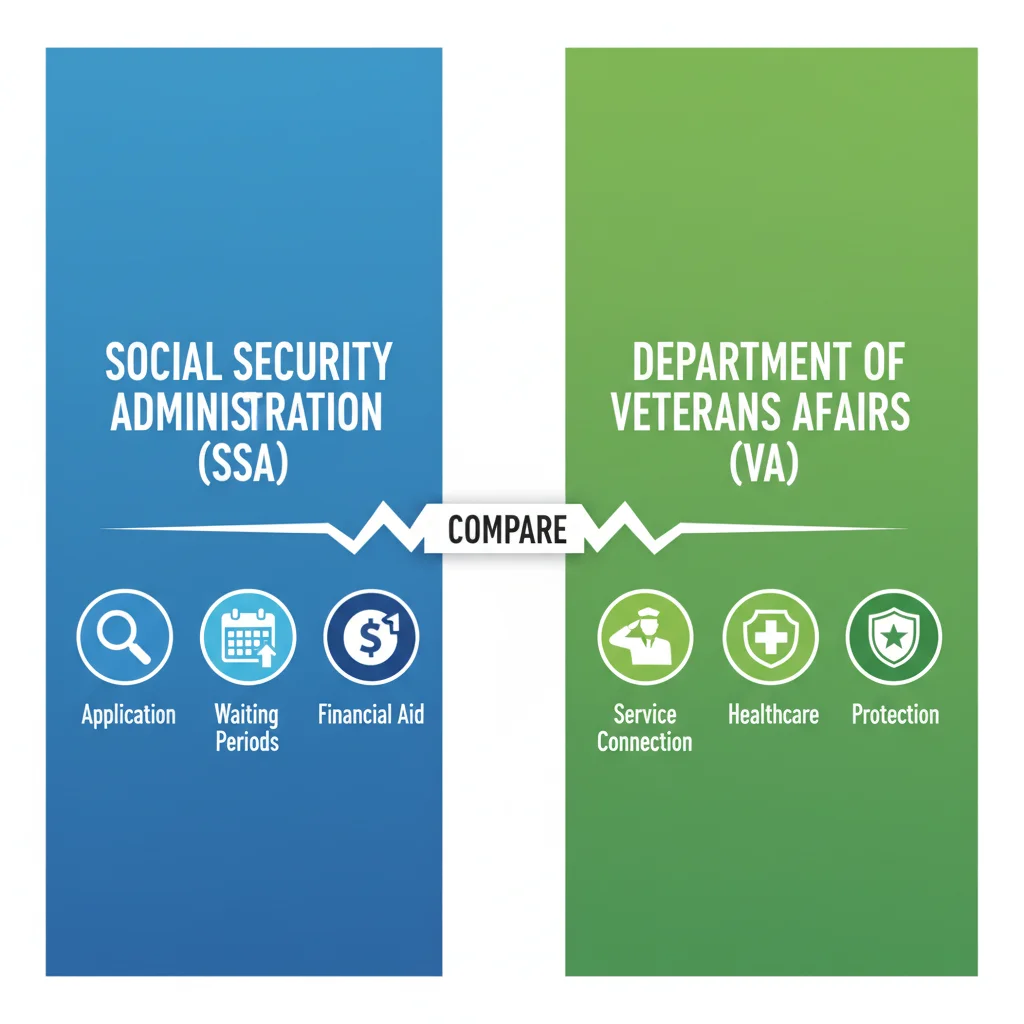
While both the SSA and VA provide crucial support, understanding their fundamental differences is vital when considering which program to pursue, or if you can pursue both for your 2026 disability benefits.
1. Definition of Disability:
- SSA: Requires an inability to perform any substantial gainful activity due to a severe impairment that is expected to last at least 12 months or result in death. It’s an “all or nothing” determination regarding work capacity.
- VA: Focuses on the degree of impairment caused by service-connected conditions, regardless of whether you can work. A veteran can have a 100% VA disability rating and still be employed, though certain ratings (like Total Disability Individual Unemployability – TDIU) specifically address inability to work.
2. Work History Requirement:
- SSDI: Requires a significant work history with Social Security tax contributions.
- SSI: No work history required; based on financial need.
- VA: No work history required; based on military service and service-connected disability.
3. Financial Need:
- SSDI: Not needs-based; benefits are tied to past earnings.
- SSI: Strictly needs-based; income and resource limits apply.
- VA: Generally not needs-based for basic compensation, though some additional benefits (like Aid and Attendance) have income thresholds.
4. Healthcare Coverage:
- SSDI: Medicare after a waiting period.
- SSI: Medicaid (in most states).
- VA: VA healthcare system for service-connected conditions and often for other medical needs, depending on priority group.
5. Simultaneous Benefits:
It is possible, and often beneficial, for veterans to receive both VA disability compensation and SSA disability benefits (SSDI or SSI). These programs do not offset each other dollar-for-dollar. VA disability compensation is not considered countable income for SSDI purposes, and while it is considered income for SSI, it is often excluded or partially excluded depending on other factors. This means a veteran could receive both monthly VA payments and monthly SSA payments, significantly enhancing their financial stability. If you are a veteran seeking 2026 disability benefits, you should explore both avenues.
Applying for 2026 Disability Benefits: What to Expect
The application process for both SSA and VA disability benefits can be lengthy and complex. Preparation is key to a successful outcome.
Applying for SSA Disability (SSDI/SSI)
1. Gather Documentation
You’ll need extensive medical records detailing your condition, treatments, prognoses, and how your impairment affects your ability to perform work-related activities. This includes doctor’s notes, hospital records, lab results, imaging scans, and therapy notes. Also gather work history information, educational records, and financial documents (for SSI).
2. File Your Application
You can apply online, by phone, or in person at your local Social Security office. The application asks for detailed information about your medical condition, treatment providers, work history, and daily activities.
3. Initial Review
Your application will first be reviewed by the local Social Security office for technical eligibility (work credits for SSDI, income/resources for SSI). Then, it’s sent to a state Disability Determination Services (DDS) agency.
4. DDS Medical Review
DDS adjudicators, who are state agency employees, will review your medical evidence. They may contact your doctors, send you for a consultative examination (CE) with an SSA-contracted doctor, or request additional information. Their goal is to determine if your condition meets the SSA’s definition of disability.
5. Decision and Appeals
Most initial applications are denied. If denied, you have the right to appeal. The appeals process typically involves several stages:
- Reconsideration: A new reviewer at DDS re-examines your case.
- Hearing by an Administrative Law Judge (ALJ): If denied at reconsideration, you can request a hearing before an ALJ. This is often where applicants have the best chance of approval, especially with legal representation.
- Appeals Council Review: If denied by an ALJ, you can ask the Appeals Council to review the ALJ’s decision.
- Federal Court Review: As a last resort, you can file a lawsuit in federal district court.
The entire process can take many months, or even years, so patience and persistence are crucial when applying for 2026 disability benefits.
Applying for VA Disability Compensation
1. Gather Documentation
You will need your military service records (DD-214), medical records from your time in service, current private medical records related to your disability, and any other evidence supporting your claim (e.g., buddy statements, personal statements).
2. File Your Claim
You can file a claim online through VA.gov, by mail, or with the help of an accredited Veterans Service Officer (VSO). A VSO can be an invaluable resource, helping you gather evidence, complete forms, and track your claim.
3. VA Review and Examinations
The VA will review your evidence. They may schedule you for a Compensation and Pension (C&P) exam. This exam, conducted by a VA or VA-contracted physician, is critical for establishing the nature and severity of your condition and its connection to service.
4. Decision and Appeals
Once the VA makes a decision, you will receive a rating decision letter. If you disagree with the decision, you have several appeal options under the VA’s modernized Appeals Modernization Act (AMA) system:
- Supplemental Claim: Submit new and relevant evidence.
- Higher-Level Review: Request a senior reviewer to re-examine your existing evidence for errors.
- Board Appeal: Appeal directly to the Board of Veterans’ Appeals. You can choose different review options at the Board, including a direct review, evidence submission, or a hearing.
The VA claims process can also be lengthy, though the AMA system aims to streamline appeals. Veterans often find that working with a VSO significantly improves their chances of a successful outcome.
Maximizing Your Chances for 2026 Disability Benefits Approval
Regardless of whether you’re applying to the SSA or the VA, several strategies can help strengthen your claim for 2026 disability benefits:
- Seek Consistent Medical Treatment: Regular medical care and adherence to prescribed treatments are paramount. Your medical records are the backbone of your claim. Gaps in treatment can suggest your condition is not as severe as claimed.
- Be Thorough and Detailed: Provide as much specific information as possible about your condition, symptoms, functional limitations, and how these impact your daily life and ability to work. Don’t assume the adjudicator knows your full story.
- Follow Doctor’s Orders: Show that you are actively trying to manage your condition. If you don’t follow prescribed treatments, the SSA or VA might view it as non-compliance, potentially hindering your claim.
- Keep Copies of Everything: Maintain organized files of all documents submitted and received, including medical records, application forms, and correspondence.
- Consider Professional Assistance:
- For SSA: An experienced disability attorney or advocate can significantly improve your chances, especially at the ALJ hearing level. They understand the legal framework, can gather necessary evidence, and represent you effectively.
- For VA: An accredited Veterans Service Officer (VSO) is often the best first point of contact. They provide free assistance and are experts in VA claims. Attorneys specializing in VA law can also be beneficial, particularly for complex appeals.
- Be Patient and Persistent: The process is rarely quick. Be prepared for delays and potential denials, but don’t give up. Many successful claims are approved after an appeal.

Future Outlook for 2026 Disability Benefits
As we approach 2026, there are always potential changes and updates to federal benefit programs. While specific legislative changes are hard to predict, it’s wise to stay informed:
- Cost-of-Living Adjustments (COLAs): Both SSA and VA benefits typically receive annual COLAs to help beneficiaries keep pace with inflation. These are usually announced in the fall for the following year.
- Policy and Regulatory Updates: The SSA and VA regularly update their policies, regulations, and medical criteria. Staying informed through official government websites (SSA.gov, VA.gov) or reputable disability advocacy groups is important.
- Technological Advancements: Both agencies continue to embrace technology to streamline applications and communications. Utilizing online portals and digital submission methods can often expedite parts of the process.
For those planning to apply for 2026 disability benefits, it’s crucial to acknowledge that the underlying principles of eligibility and the need for robust medical evidence will remain constant. The best preparation involves meticulously documenting your medical condition and understanding the specific requirements of the program you are applying to.
Conclusion: Securing Your 2026 Disability Benefits
Navigating the complex world of federal disability benefits requires diligence, understanding, and often, professional guidance. Whether you are seeking assistance through the Social Security Administration’s SSDI or SSI programs, or through the Department of Veterans Affairs for service-connected conditions, the journey to securing your benefits can be challenging but ultimately rewarding.
By understanding the distinct eligibility criteria, application processes, and the types of support offered by each program, you can strategically plan your approach. Remember that comprehensive medical documentation, consistent treatment, and a clear understanding of how your disability impacts your ability to function are paramount to a successful claim.
For veterans, exploring both VA and SSA benefits concurrently can provide a robust safety net. For all applicants, seeking assistance from accredited professionals – be it a VSO, a disability attorney, or an advocate – can significantly ease the burden and improve the likelihood of approval. As you prepare for your 2026 disability benefits application, arm yourself with knowledge, gather your evidence meticulously, and advocate for the support you deserve.
The path to obtaining disability benefits may be long, but with careful preparation and perseverance, you can achieve the financial security and healthcare access necessary to manage your condition and improve your quality of life. Don’t hesitate to reach out to the resources available to you; they are there to help you every step of the way.