AI Revolutionizing Fashion Design: Top 4 Tools for US Industry in 2026
Advertisement
The Impact of AI on Fashion Design: 4 Tools Revolutionizing US Industry in 2026 (RECENT UPDATES)
The fashion industry, long celebrated for its creativity and artistry, is undergoing a profound transformation, driven by the relentless march of artificial intelligence. From conceptualization to production, and even retail, AI is not just augmenting human capabilities but fundamentally reshaping the landscape of design. As we approach 2026, the United States fashion industry is poised to witness an unprecedented integration of AI, leading to innovations that promise greater efficiency, personalization, and sustainability.
This article delves into the burgeoning role of AI Fashion Design Tools and explores how these technologies are set to revolutionize the US industry. We’ll uncover the recent updates and spotlight four groundbreaking AI tools that are not merely trends but foundational shifts in how fashion is conceived, created, and consumed. Prepare to explore a future where algorithms inspire couture, and data drives design decisions.
The Dawn of Algorithmic Creativity: Why AI in Fashion Matters
For centuries, fashion design has been a deeply human endeavor, relying on intuition, cultural understanding, and artistic flair. However, the complexities of modern markets, the demand for rapid trend adaptation, and the urgent need for sustainable practices have opened the door for AI. AI offers solutions to these challenges, providing designers with powerful capabilities previously unimaginable.
Advertisement
The integration of AI Fashion Design Tools is not about replacing human designers but empowering them. AI can analyze vast datasets of fashion trends, consumer preferences, sales figures, and even social media sentiment to predict what will be popular next. This predictive analytics capability allows designers to make more informed decisions, reducing waste and increasing the likelihood of commercial success. Moreover, AI can automate repetitive tasks, freeing up designers to focus on higher-level creative work.
Key Drivers for AI Adoption in US Fashion:
- Speed to Market: AI accelerates design cycles, allowing brands to respond to trends in real-time.
- Personalization at Scale: AI enables the creation of highly customized garments tailored to individual consumer preferences.
- Sustainability Initiatives: AI optimizes material usage, reduces prototyping waste, and identifies eco-friendly alternatives.
- Supply Chain Optimization: AI predicts demand more accurately, leading to less overproduction and more efficient logistics.
- Enhanced Creativity: AI acts as a co-creator, generating novel design concepts and variations that human designers might not conceive.
The US fashion industry, known for its dynamic nature and embrace of innovation, is particularly fertile ground for these advancements. Major brands and emerging startups alike are investing heavily in AI research and development, recognizing that these technologies are not just a competitive advantage but a necessity for future relevance.
Revolutionizing Design Processes with AI
The impact of AI extends across the entire design process, from initial sketch to final product. Traditional methods, often time-consuming and resource-intensive, are being streamlined and enhanced by intelligent algorithms. This shift is creating a more agile and responsive design ecosystem.
Advertisement
From Concept to Creation: AI’s Role
One of the most exciting applications of AI Fashion Design Tools is in the ideation phase. AI can generate countless design variations based on specific parameters, such as style, color, fabric, and target demographic. This capability drastically reduces the time spent on brainstorming and initial sketching, allowing designers to explore a wider range of possibilities.
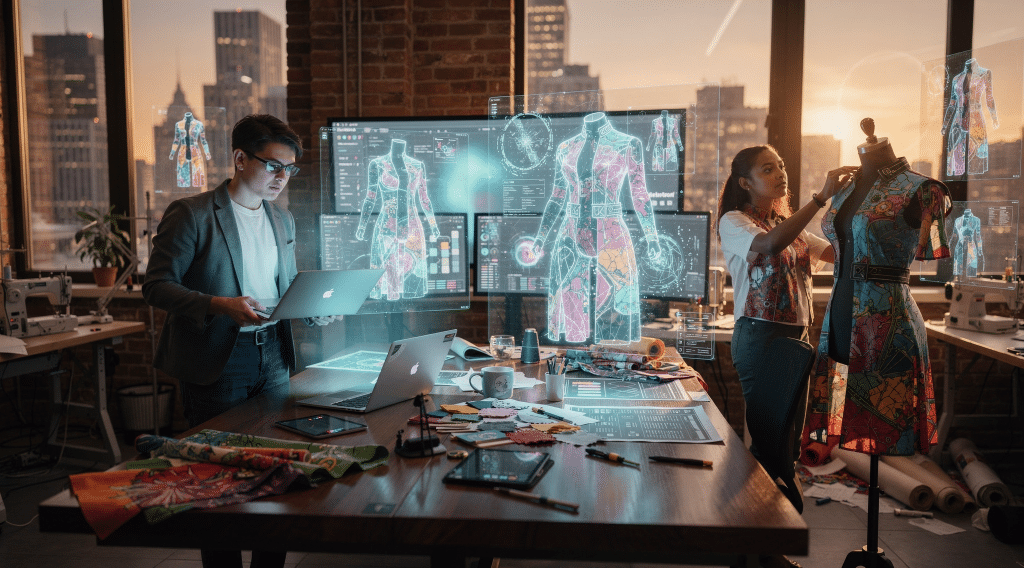
Furthermore, AI-powered software can simulate how different fabrics will drape and move, or how colors will appear under various lighting conditions, all before a single physical sample is created. This virtual prototyping not only saves money and materials but also significantly shortens the product development cycle.
The ability of AI to analyze and synthesize complex visual data means it can even learn and mimic the aesthetic styles of specific designers or brands, creating new pieces that are consistent with an established identity while still offering novel elements. This symbiotic relationship between human creativity and algorithmic power is defining the next generation of fashion design.
Top 4 AI Fashion Design Tools Revolutionizing the US Industry by 2026
As the landscape of fashion technology evolves, several AI Fashion Design Tools are emerging as frontrunners, poised to make a significant impact on the US industry by 2026. These tools leverage various AI capabilities, from generative design to predictive analytics and virtual prototyping, offering comprehensive solutions for modern designers and brands.
1. Generative Design Platforms: Automated Creativity
Generative design is perhaps the most captivating application of AI in fashion. These platforms use algorithms to create novel design options based on input criteria. Instead of a designer drawing a garment, they might define parameters like ‘elegant evening wear,’ ‘sustainable casual,’ or ‘futuristic streetwear,’ and the AI generates numerous unique concepts.
One prominent example of this technology that is gaining traction in the US is Replicant Fashion AI (RFAI). RFAI utilizes advanced neural networks to produce garment silhouettes, textile patterns, and even entire collections. Designers can input mood boards, historical data, or current trend reports, and RFAI will output a diverse range of design ideas, complete with 3D visualizations. This tool is particularly valuable for accelerating the initial creative phase and ensuring designers explore a broad spectrum of possibilities, often uncovering unexpected yet brilliant solutions.
The power of generative design lies in its ability to break creative blocks and offer fresh perspectives, pushing the boundaries of traditional aesthetics. By 2026, RFAI and similar platforms are expected to be indispensable for design houses looking to maintain a competitive edge in fast-paced markets.
2. Predictive Analytics & Trend Forecasting AI: Staying Ahead of the Curve
Understanding future trends is paramount in fashion. Historically, this has involved a mix of intuition, market research, and observation. Now, AI Fashion Design Tools are transforming trend forecasting into a data-driven science. Predictive analytics platforms can process vast amounts of data from social media, e-commerce sales, fashion shows, news articles, and even satellite imagery to identify emerging patterns and predict consumer demand with remarkable accuracy.
TrendSense AI is one such tool making waves. It leverages machine learning to analyze global fashion data, identifying micro-trends before they become mainstream. For US brands, this means being able to anticipate consumer preferences months in advance, optimizing inventory, reducing waste from unsold goods, and launching collections that resonate deeply with their target audience. TrendSense AI doesn’t just tell you what’s popular; it explains why it’s popular and predicts its longevity, providing invaluable insights for design and merchandising teams.
By 2026, integrating such predictive capabilities will be standard practice, allowing US fashion companies to minimize financial risks associated with overproduction and missed trends, fostering a more sustainable and profitable industry.
3. Virtual Prototyping & 3D Simulation Software: Efficiency and Sustainability
The traditional process of creating physical samples is costly, time-consuming, and resource-intensive. Virtual prototyping, powered by AI and advanced 3D rendering, is set to revolutionize this aspect of fashion design. These AI Fashion Design Tools allow designers to create highly realistic 3D models of garments that can be viewed from all angles, draped on virtual avatars, and even animated to simulate movement.
MetaWear Studio is emerging as a leading solution in this space. It offers designers the ability to create digital twins of their garments, experiment with different fabrics, textures, and fits, and visualize them on diverse body types without producing a single physical sample. MetaWear Studio’s AI algorithms ensure accurate fabric simulation, accounting for stretch, drape, and opacity, making the virtual prototypes almost indistinguishable from real garments.
The benefits are immense: reduced material waste, faster iteration cycles, lower development costs, and the ability to present collections to buyers or consumers virtually before production even begins. In the US, where sustainability and speed are increasingly critical, MetaWear Studio is expected to be a cornerstone technology by 2026, streamlining the entire product development pipeline.
4. AI-Powered Personalization and Customization Platforms: The Future of Consumer Engagement
The demand for personalized products is growing, and AI is uniquely positioned to meet this need in the fashion industry. AI Fashion Design Tools are enabling brands to offer highly customized garments and accessories, moving away from mass production towards a more bespoke approach at scale.
StyleGenie AI is an innovative platform that empowers consumers to co-create their own fashion pieces. Through an intuitive interface, users can select styles, colors, patterns, and even fabric types, with AI guiding their choices based on their preferences, body shape, and current trends. The AI can then generate a unique design and even suggest modifications to ensure optimal fit and aesthetic appeal. For brands, StyleGenie AI provides a powerful tool to engage customers, gather valuable preference data, and offer a truly unique shopping experience.
By 2026, such platforms will allow US brands to tap into the lucrative market of personalized fashion, fostering deeper customer loyalty and creating a more inclusive and diverse range of products that cater to individual tastes, moving beyond standard sizing and limited options.
Challenges and Ethical Considerations in AI Fashion Design
While the promise of AI Fashion Design Tools is immense, their widespread adoption also brings challenges and ethical considerations that the US industry must address. These include data privacy, algorithmic bias, and the potential impact on human employment.
Data Privacy and Security:
AI models are trained on vast datasets, often including consumer preferences and personal measurements. Ensuring the secure handling and ethical use of this data is paramount. Robust data governance frameworks and transparent privacy policies will be crucial for building consumer trust.
Algorithmic Bias:
AI systems learn from the data they are fed. If this data contains historical biases (e.g., predominantly featuring certain body types, ethnicities, or gender expressions), the AI may perpetuate or even amplify these biases in its designs. The US fashion industry must actively work to curate diverse and inclusive datasets to ensure that AI-generated designs are representative of all consumers.
The Future of Human Creativity:
A common concern is whether AI will diminish the role of human designers. However, as discussed, the current trajectory suggests AI acts as a powerful assistant, augmenting human capabilities rather than replacing them. The challenge lies in training the next generation of designers to effectively collaborate with AI, leveraging its strengths while maintaining their unique creative vision and critical judgment.
Addressing these challenges proactively will be key to unlocking the full potential of AI in fashion and ensuring its responsible and beneficial integration into the US industry.
The Economic and Creative Landscape Post-AI Integration
The widespread integration of AI Fashion Design Tools is set to fundamentally alter the economic and creative landscape of the US fashion industry. Economically, we can anticipate increased efficiency, reduced waste, and the opening of new revenue streams through hyper-personalization and faster trend response. Brands that embrace AI early are likely to gain significant market share.
Creatively, AI will foster an environment of radical experimentation. Designers, freed from mundane tasks, will have more time and resources to explore avant-garde concepts, sustainable materials, and innovative silhouettes. The collaboration between human intuition and algorithmic precision could lead to entirely new aesthetic movements and design philosophies.
Moreover, AI can democratize design, making advanced tools accessible to independent designers and smaller brands, fostering a more diverse and competitive industry. The ability to quickly prototype, forecast trends, and personalize designs will level the playing field, allowing creativity to flourish irrespective of budget size.
Case Studies: Early Adopters and Their Successes
While 2026 is still a few years away, several US brands are already experimenting with AI Fashion Design Tools, offering a glimpse into the future. For instance, a major sportswear brand used generative AI to design unique sneaker patterns based on athletic performance data, leading to a highly successful limited-edition release. Another luxury brand leveraged predictive analytics to fine-tune its seasonal collections, resulting in a significant reduction in unsold inventory and a boost in profit margins.
These early successes underscore the tangible benefits of AI. They demonstrate that AI is not just a theoretical concept but a practical tool delivering real-world value, enhancing both the bottom line and creative output.
Preparing for 2026: What US Fashion Businesses Need to Do Now
For US fashion businesses looking to thrive in the AI-driven future, proactive steps are essential. Investing in talent development, exploring pilot programs with AI vendors, and fostering a culture of innovation are crucial.
Key Recommendations:
- Educate and Train: Invest in upskilling design and production teams in AI literacy and the use of new AI tools.
- Pilot Programs: Start small with pilot projects, testing AI tools in specific areas like trend forecasting or virtual prototyping.
- Data Strategy: Develop a robust data collection and analysis strategy, as clean, relevant data is the fuel for effective AI.
- Collaborate: Partner with AI technology providers and research institutions to stay at the forefront of innovation.
- Embrace Change: Foster an organizational culture that is open to technological change and continuous learning.
The fashion industry of 2026 will undoubtedly look different from today. Those who embrace the transformative power of AI Fashion Design Tools will not only survive but thrive, leading the charge into a new era of creativity, efficiency, and sustainability.
Conclusion: The Future is Designed by AI and Human Ingenuity
The integration of artificial intelligence into fashion design is not merely an evolutionary step but a revolutionary leap. By 2026, the US fashion industry will be profoundly shaped by the innovations brought forth by AI Fashion Design Tools like Replicant Fashion AI, TrendSense AI, MetaWear Studio, and StyleGenie AI. These tools promise to unlock unprecedented levels of creativity, optimize operational efficiencies, and pave the way for a more sustainable and personalized future for fashion.
While challenges remain, the clear benefits and transformative potential of AI make its adoption inevitable and desirable. The future of fashion design is a collaborative endeavor, where the boundless imagination of human designers merges with the analytical power of artificial intelligence, creating a vibrant, dynamic, and responsive industry ready for the demands of the 21st century.